AI in the Kitchen: Save Money, Reduce Stress, Eat Better
Food is close to our family’s heart. We love cooking, sharing meals, and gathering around a table with each other and friends. And that’s exactly why I love the idea of “Gentle AI” in the kitchen.
Not because we want a robot to take over dinner — but because life gets busy, groceries are expensive, and “What’s for dinner?” can feel like a daily pressure point.
AI can help you get more value, simplicity, and variety at home — whether you’re feeding a family, cooking for one, or planning a special meal for guests.
Here are the most useful ways to use it.
1) Shop smarter and save money
Ask AI which supermarkets are best value near you
If budgeting matters (and honestly, it does for most of us), AI can help you think strategically about where to shop.
Try prompts like:
- “What are the best-value supermarkets near [your suburb] and why?”
- “Which stores are usually best for fresh produce vs pantry items?”
- “What are the best budget choices for protein, vegetables, and snacks?”
AI won’t replace checking prices in real time — but it can help you start in the right place and make smarter habits.
Find a specific product without driving everywhere
We’ve all done that “trudging from centre to centre” thing trying to find one particular item.
Instead, try:
- “Where is the nearest place to buy [product] near [suburb]?”
- “What’s the cheapest option for [product] around [suburb]?”
- “If it’s out of stock, what are the closest alternatives?”
This is especially handy for unusual ingredients, baking items, special dietary foods, or cookware.
Compare delivery costs and days for your postcode
Online shopping can make a surprising difference to the budget (especially if it reduces impulse buys).
Try:
- “Compare supermarket delivery fees and delivery days for [postcode].”
- “Which supermarket offers the best delivery value for [suburb/postcode]?”
- “Help me shop online with a strict budget of $X — suggest a weekly list.”
2) Meal plans that match your health goals (and your real life)
There are endless possibilities once you let your imagination flow. AI becomes an assistant that can help you plan, organise, and manage meal-time requirements.
Two-week menu plans for health needs
Examples:
- “Please help me prepare a 2-week menu plan that is low carb, low salt, minimises sugar, and allows dessert (no fake additives).”
- “I don’t tolerate [list foods]. Please design a 14-day menu that avoids these and still feels satisfying.”
- “I’m cooking for two adults. Keep it simple and repeat ingredients to reduce waste.”
Or the opposite: healthy weight gain
AI can also help if your goal is weight gain:
- “I have to put on weight. Please design me a healthy 14-day menu to help me gain weight, with nourishing snacks and higher-calorie meals.”
Allergies, preferences, restrictions
This is one of the best uses of AI:
- “I’m allergic to [X] and I avoid [Y]. Please give me dinner ideas that fit.”
- “Give me a weekly menu that is gluten-free/dairy-free/low FODMAP/vegetarian.”
Gentle note: if you have medical conditions, it’s still wise to check changes with your GP or dietitian — but AI is fantastic for ideas and structure.
3) Instant dinner inspiration when time gets away from you
How often does it happen that unexpected guests arrive… or you’re engrossed in something and suddenly it’s dinner time?
AI is amazing here.
“Use what I’ve got” cooking
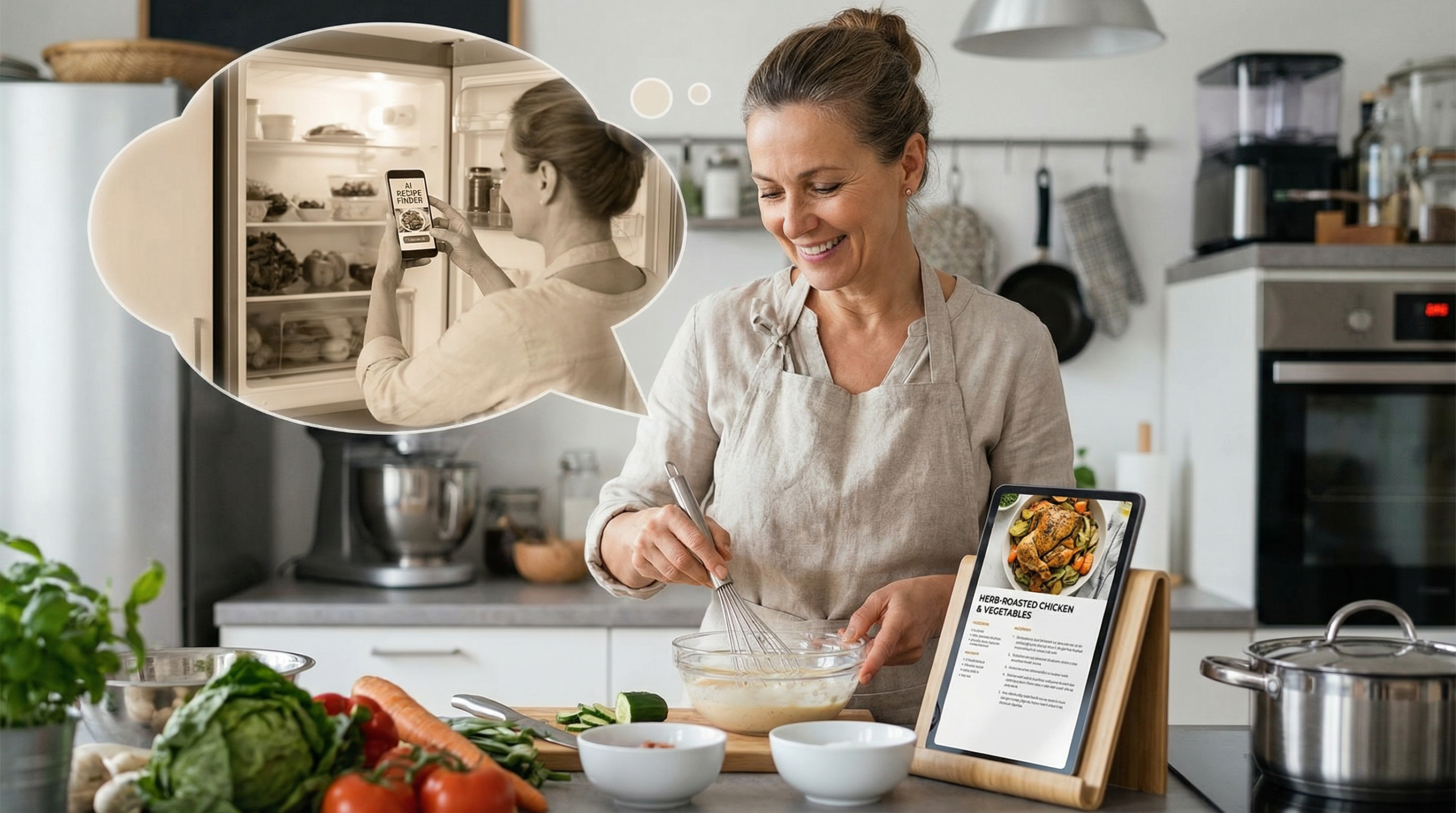
You can type what you have, or (if your AI allows images) take a photo of your fridge and ask for ideas.
For example:
“I need to use up the cream and chicken I have. What could I cook? I also have mushrooms and a tin of tomatoes.”
AI can suggest ideas along with recipes such as:
- creamy tomato chicken with mushrooms
- a quick pasta bake or casserole
- chicken stroganoff-style twist
- soup or a one-pan dinner
…and it can tailor the ideas to your equipment and time.
Recently I did this with some fennel and fig paste partially use on a cheeseboard, and AI inspired me to use it to add richness to a pork dish. It was very successful.”
That’s the magic: AI nudges you into combinations you might not have thought of — without changing your style.
4) Ingredient swaps when you’re missing something
Have you ever had a recipe half underway and realised you’re missing one or two ingredients… and thought you couldn’t proceed?
Often, you can — and AI is great at suggesting replacements.
Try:
- “I’m missing [ingredient]. What can I substitute that will still work?”
- “Here’s the recipe (paste it). Suggest swaps for [ingredient].”
- “I don’t tolerate [ingredient]. What’s a good alternative?”
This is especially helpful for:
- dairy swaps (cream, milk, butter)
- gluten-free flour swaps
- replacing wine in sauces
- sugar reduction ideas
- missing herbs/spices
5) Cooking lessons and techniques (from beginner to confident)
AI can also act like a gentle cooking tutor.
Ask for simple how-to help
- “How do I boil an egg perfectly?”
- “How do I cook rice so it’s fluffy?”
- “What’s the best way to chop an onion safely?”
Ask for video guidance
- “Can you recommend a video for preparing a tasty stir-fry dish?”
- “Can you recommend a video that steps me through sous vide steak?”
This is wonderful for building confidence — and it’s also great if you’re trying a new method and want a calm, step-by-step guide.
Copy-and-paste prompt pack
AI for Food + Shopping
- “I live near [suburb/postcode]. Which supermarkets are best value here and why?”
- “Compare delivery fees and delivery days for [postcode].”
- “Here’s what I have: [ingredients]. Give me 5 dinner ideas (quick, healthy, comfort, guest-worthy, and leftovers-friendly).”
- “Create a 14-day menu plan that is [low carb / low salt / gluten-free] and avoids [foods].”
- “I need to gain weight in a healthy way. Create a 14-day menu with nourishing snacks.”
- “I’m missing [ingredient]. What can I substitute?”
- “I want to learn [technique]. Explain it simply and recommend a beginner-friendly video.”
“Be my gentle tech tutor. I’m using [brand + model] and trying to [task]. Explain in simple steps like I’m new to this.”
A quick “common sense” reminder
AI is a brilliant helper — but you’re still the decision-maker. Always consider allergies, food safety, and any medical advice you’ve been given.
Closing / gentle encouragement
If food is a big part of your home life — or you simply want less stress and more variety — AI can be like a calm extra set of hands in the background.
Start small:
- ask for one dinner idea
- ask for one ingredient swap
- ask for a simple 3-day plan
And you might be surprised how quickly meal-time becomes easier — and even more enjoyable.